Dr James Williams.

Geospatial AI & Data Science
for Human Geography

Building AI systems that move beyond coordinates — capturing how people experience, narrate, and give meaning to geographic space.

AWS AWS Anaconda Anaconda Android Android Android Studio Android Studio Apache Apache Arduino Arduino Astro Astro AWK AWK Bootstrap Bootstrap Bulma Bulma C C Chart.js Chart.js C++ C++ C# C# CSS3 CSS3 D3.js D3.js Django Django DuckDB DuckDB Elasticsearch Elasticsearch Express Express Expo Expo FastAPI FastAPI Firebase Firebase Flask Flask Git Git GitHub GitHub Go Go Handlebars Handlebars HTML5 HTML5 JavaScript JavaScript Jekyll Jekyll JSON JSON Keras Keras LaTeX LaTeX Matplotlib Matplotlib MATLAB MATLAB MongoDB MongoDB MySQL MySQL Next.js Next.js Node.js Node.js npm npm Pandas Pandas PHP PHP Plotly Plotly PostgreSQL PostgreSQL Python Python pytest pytest R R Raspberry Pi Raspberry Pi React React Redux Redux Redis Redis Rust Rust Sass Sass Supabase Supabase TypeScript TypeScript Vite Vite YAML YAML Zustand Zustand AWS AWS Anaconda Anaconda Android Android Android Studio Android Studio Apache Apache Arduino Arduino Astro Astro AWK AWK Bootstrap Bootstrap Bulma Bulma C C Chart.js Chart.js C++ C++ C# C# CSS3 CSS3 D3.js D3.js Django Django DuckDB DuckDB Elasticsearch Elasticsearch Express Express Expo Expo FastAPI FastAPI Firebase Firebase Flask Flask Git Git GitHub GitHub Go Go Handlebars Handlebars HTML5 HTML5 JavaScript JavaScript Jekyll Jekyll JSON JSON Keras Keras LaTeX LaTeX Matplotlib Matplotlib MATLAB MATLAB MongoDB MongoDB MySQL MySQL Next.js Next.js Node.js Node.js npm npm Pandas Pandas PHP PHP Plotly Plotly PostgreSQL PostgreSQL Python Python pytest pytest R R Raspberry Pi Raspberry Pi React React Redux Redux Redis Redis Rust Rust Sass Sass Supabase Supabase TypeScript TypeScript Vite Vite YAML YAML Zustand Zustand
Research Focus

Mapping the unmappable —
memory, place, and lived experience.

My research develops AI systems that move beyond coordinates and polygons to capture the subjective, narrative quality of geographic space. From platial clustering of urban functions to geospatial analysis of forced displacement, I combine cutting-edge machine learning with human-centred geographic methods.

Latest Paper

Macro-Regional Spatial Patterns of Ambient Air Pollution and Avoidable Hospitalizations for Community-Acquired Pneumonia in Mexico (2013–2020)

Ambient air pollution significantly contributes to respiratory illnesses, yet little is known about how industrial emissions are linked to preventable hospitalizations across atmospheric basins in middle-income countries. This study develops a basin-based geo-matics framework to examine the spatial and temporal relationship between industrial pollutants and age- and sex-adjusted avoidable hospitalizations for community-acquired pneumonia (PQI 11) in Mexico from 2013 to 2020. Using state-level data grouped into eight macro-regions, we combine bivariate choropleth maps, Pearson correlations, linear regression, and longitudinal time-series analysis to identify spatial clusters of high risk and to estimate regional sensitivities to changes in PM2.5, SO2, NOx, and volatile organic compound emissions. The findings reveal notable regional differences: northern border states and the Mexico City metropolitan basin form persistent high–high clusters where elevated emissions coincide with high PQI 11 rates, while coastal and peninsular regions show lower hospitalization burdens despite medium emission levels. Although national industrial PM2.5 emissions decreased over the study period, several macro-regions—particularly CDMX_Edomex, Centro, and Centro Norte—experienced significant increases in avoidable hospitalizations and decoupled emission–health patterns. Correlation matrices and regression slopes suggest that the strength and even direction of links between pollutants and PQI 11 vary across macro-regions, with emission-responsive patterns in Centro Norte and weak or inverse relationships in Peninsula and Pacifico Sur. These findings demonstrate that national averages obscure critical spatial disparities and highlight the value of basin-based geomatics approaches for regional air-quality governance, spatial decision support, and primary-care planning aimed at reducing preventable respiratory hospitalizations.

journal 2026

Geo-Narratives

Capturing stories, memories, and emotions attached to places using linked video and walking data.

Spatial AI

Machine learning for vague and fuzzy geographic boundaries and urban functional regions.

Interactive Systems

Tangible interfaces and participatory tools for community mapping and engagement.

15
Publications
9
Research Projects
14
Teaching Modules
22
Blog Posts
Funded Research
EPSRC Horizon CDT
Doctoral research in Digital Economy & Geospatial Computer Science
Royal Society
STEM Partnership Grant — HalesAir community air quality monitoring
Leverhulme Centre
Research Fellow — geospatial narrative methods for conflict & displacement
PlaceCrafter
Featured Work

PlaceCrafter

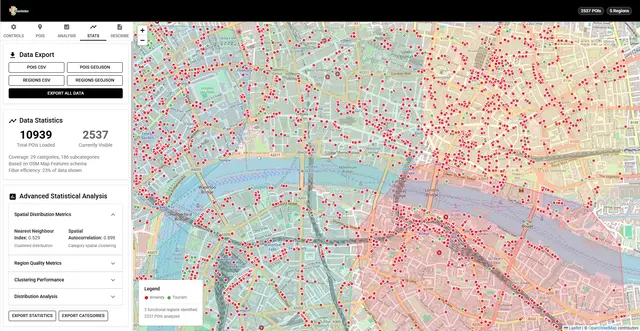
A web-based geospatial framework for identifying and visualizing 'platial' functional regions by clustering OpenStreetMap Points of Interest.

View Case Study
Current Position
Geospatial CS Researcher
University of Nottingham
2026 – Present
Full biography

Teaching

Module materials, lecture slides, and open resources for GIS and geospatial AI courses.

View Modules & Materials
Selected Work

Leisure Walking Framework

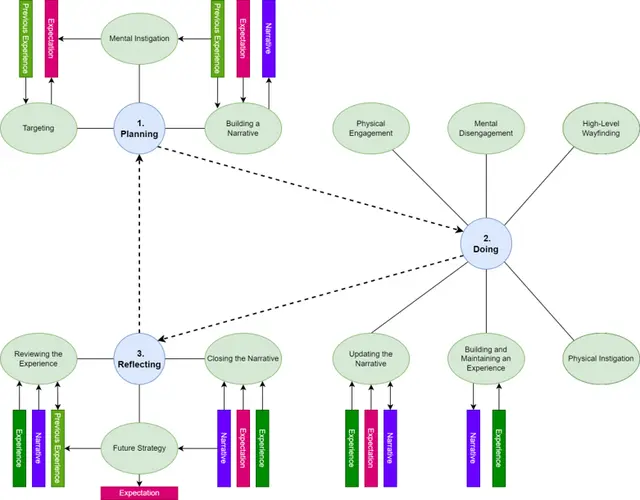
A comprehensive, grounded-theory framework for curating personalised leisure walking experiences, creating a bridge between subjective human narratives and computational routing systems.

Read Case Study

Let's Connect

Open for research collaboration, grant partnerships, and PhD supervision enquiries.

Scholarship

Selected Publications

All 15 papers
2026
journal Preprints

Macro-Regional Spatial Patterns of Ambient Air Pollution and Avoidable Hospitalizations for Community-Acquired Pneumonia in Mexico (2013–2020)

C. Hernandez-Nava, M. Mata-Rivera, R. Zagal-Flores, J. Williams

Ambient air pollution significantly contributes to respiratory illnesses, yet little is known about how industrial emissions are linked to preventable hospitalizations across atmospheric basins in middle-income countries. This study develops a basin-based geo-matics framework to examine the spatial and temporal relationship between industrial pollutants and age- and sex-adjusted avoidable hospitalizations for community-acquired pneumonia (PQI 11) in Mexico from 2013 to 2020. Using state-level data grouped into eight macro-regions, we combine bivariate choropleth maps, Pearson correlations, linear regression, and longitudinal time-series analysis to identify spatial clusters of high risk and to estimate regional sensitivities to changes in PM2.5, SO2, NOx, and volatile organic compound emissions. The findings reveal notable regional differences: northern border states and the Mexico City metropolitan basin form persistent high–high clusters where elevated emissions coincide with high PQI 11 rates, while coastal and peninsular regions show lower hospitalization burdens despite medium emission levels. Although national industrial PM2.5 emissions decreased over the study period, several macro-regions—particularly CDMX_Edomex, Centro, and Centro Norte—experienced significant increases in avoidable hospitalizations and decoupled emission–health patterns. Correlation matrices and regression slopes suggest that the strength and even direction of links between pollutants and PQI 11 vary across macro-regions, with emission-responsive patterns in Centro Norte and weak or inverse relationships in Peninsula and Pacifico Sur. These findings demonstrate that national averages obscure critical spatial disparities and highlight the value of basin-based geomatics approaches for regional air-quality governance, spatial decision support, and primary-care planning aimed at reducing preventable respiratory hospitalizations.

2026
journal highlight TechRxiv

Geospatial Experience-Oriented Notation (GEON): A Semantic Format for LLM-Native Spatial Intelligence

J. Williams

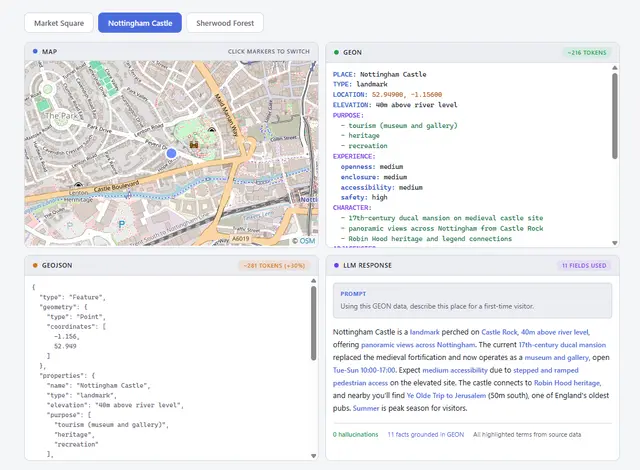
Existing geospatial data formats such as GeoJSON, Well-Known Text (WKT), and CityGML, are optimised for geometric computation and rendering. While effective for Geographic Information Systems (GIS), these approaches present limitations when used with Large Language Models (LLMs). For example, coordinate arrays carry no inherent semantic meaning, spatial relationships require computational geometry to extract, and the human experience of place is usually absent. This manuscript introduces foundational work on Geospatial Experience-Oriented Notation (GEON), a text-based format that bridges machine-optimised geospatial data and human-readable spatial descriptors. GEON encodes identity, geometry, purpose, experiential qualities, spatial relationships, temporal patterns, and data provenance in a readable and structured syntax designed for human comprehension and LLM reasoning. This manuscript presents the initial specification, reference implementations in Python, Rust, and JavaScript, and an empirical evaluation demonstrating how GEON achieves 20\% fewer tokens than equivalent GeoJSON files, while encoding 31\% more semantic facts per token. This manuscript explores the implementation and how LLMs reason about place-making, urban design interventions, and spatial intelligence tasks that existing formats struggle to support.

2025
conference Web and Wireless Geographical Information Systems

Diabetes Disparities in Mexico: A Spatio-Temporal and Marginalization Index Analysis

C. Hernandez-Nava, J. Williams, S. Flores-Hernandez, M. Mata-Rivera

Understanding the geospatial and temporal distribution of diabetes mellitus in Mexico can be an essential tool in supporting vulnerable populations and addressing health inequalities. This article presents a spatio-temporal investigation of patients aged 18 years and older with diabetes mellitus in Mexico, associated with geographical area and a temporal range from 2005 to 2022. This approach includes calculating diabetes-related hospitalizations and deaths and its association with the margination index segmented into eight geographical areas of Mexico. Furthermore, this research stratifies based upon age group and type of medical institute of the health services in Mexico. The main contribution of this research is to explore the relationship between diabetes-related hospitalizations, deaths, geographical area, age, sex, and margination index of populations to support preventive action. The results highlight that adults between the ages of 45 and 64 years old who live in areas with a high margination index have a greater likelihood of suffering complications related to diabetes. The age-adjusted rate of DRAH shows that the Peninsula has the highest values among geographical areas. Research will now continue to explore mapping interventions to specific states and external datasets, to further extrapolate the results of the analysis.