
Sensors & Technology
Each HalesAir unit is built around a Raspberry Pi Pico W paired with a Waveshare BME680 environmental sensor — from hardware to data pipeline.
System Architecture


Hardware Components
Each monitoring unit is built from these components.

Raspberry Pi Pico W
The Pico W is a compact, low-power microcontroller built around the RP2040 chip. Its built-in 2.4GHz Wi-Fi allows each unit to transmit sensor readings directly to a central server without any additional networking hardware. Programmed in MicroPython, it reads the BME680 via I2C and pushes data over Wi-Fi at regular intervals.
- Dual-core ARM Cortex-M0+ @ up to 133MHz
- 264KB SRAM · 2MB flash
- 2.4GHz 802.11n Wi-Fi (CYW43439)
- MicroPython support
- 26 multi-function GPIO pins
- I2C, SPI, UART interfaces
Waveshare BME680
A compact 4-in-1 environmental sensor capturing temperature, humidity, barometric pressure, and VOC gas in a single 27×20mm board. The onboard voltage translator makes it compatible with the Pico W's 3.3V GPIO. Connected via I2C, it provides accurate, calibrated readings suitable for long-term outdoor air quality monitoring.
- Temperature: −40 to 85°C · ±1.0°C (0–65°C)
- Humidity: 0–100%RH · ±3%RH
- Pressure: 300–1100 hPa · ±0.6 hPa
- VOC gas: IAQ index via Bosch BSEC library
- I2C interface (address configurable)
- 27 × 20mm · 3.3V/5V compatible
GeeekPi Pico W IoT Starter Kit
Used during the build and programming phase, this kit provides breadboards, a UPS module, OLED display, DHT11 sensor, servo, relay, and various electronic components. Students use it to develop and test their MicroPython code before deploying to the final sensor units.
- Raspberry Pi Pico WH (pre-soldered headers)
- 400-pin breadboard with metal plate
- Pico UPS module (18650 battery support)
- OLED display + I2C 1602 LCD
- DHT11 temperature & humidity sensor
- 18 tutorial demo projects included
Weatherproof Enclosures
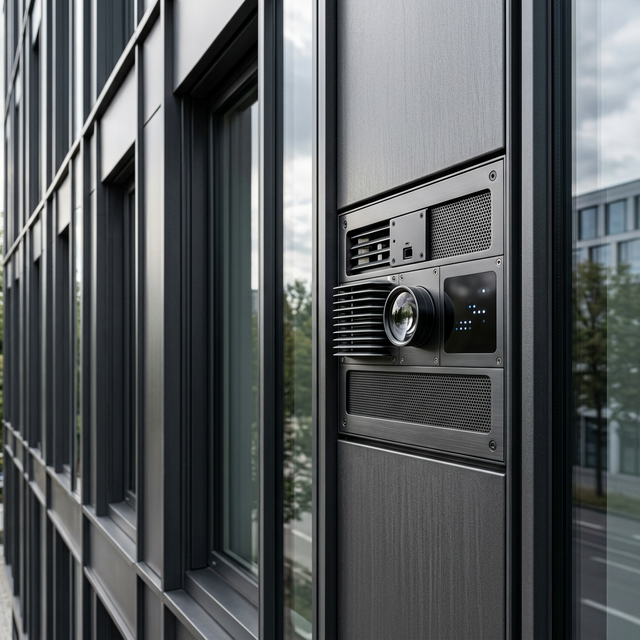
Enclosures protect the hardware from the elements during outdoor deployment. Ventilation design is critical — the housing must allow airflow to reach the BME680 sensor while preventing water ingress and direct sunlight heating that would skew temperature readings.
- Outdoor-rated (weatherproof)
- Sensor ventilation inlet
- Cable entry for power supply
- Wall or post mounting
Power Supplies
Each Pico W unit requires a stable 5V supply via its micro-USB port. Deployment sites are selected partly on the availability of mains power. The Pico W's low power consumption makes it well-suited to continuous, always-on operation.
- Micro-USB, 5V input
- Low power draw (~100–150mA typical)
- Mains-powered deployment sites
- Surge protection recommended
Software Stack
MicroPython on the Pico W handles all on-device data collection and transmission.
What We Measure
The BME680 provides four environmental parameters in one compact sensor.
Temperature
−40 to 85°C
±1.0°C (0–65°C)
Sensor placement inside enclosure requires radiation shielding to avoid self-heating bias.
Relative Humidity
0–100%RH
±3%RH
Affected by temperature; both readings are captured simultaneously for accurate correlation.
Barometric Pressure
300–1100 hPa
±0.6 hPa (0–65°C)
Useful for cross-referencing readings and identifying weather-related air quality events.
VOC Gas / IAQ
IAQ index 0–500
Qualitative (relative)
Gas resistance used to estimate indoor air quality (VOC presence). Best interpreted as a relative index, not an absolute VOC concentration.
Understanding the IAQ Index
The Bosch IAQ index goes from 0 (pristine) to 500 (hazardous). Drag the slider to explore what different values mean.
Note: the BME680 IAQ is a relative index — useful for detecting trends and comparing sites, not absolute pollutant concentrations.

Deployment Note
Site selection is a key student task. Locations are chosen to represent a range of environments — residential streets, near main roads, parks, and town centre — to capture meaningful spatial variation. All deployments require landowner permission and consideration of power access, Wi-Fi availability, physical security, and sensor ventilation within the enclosure.